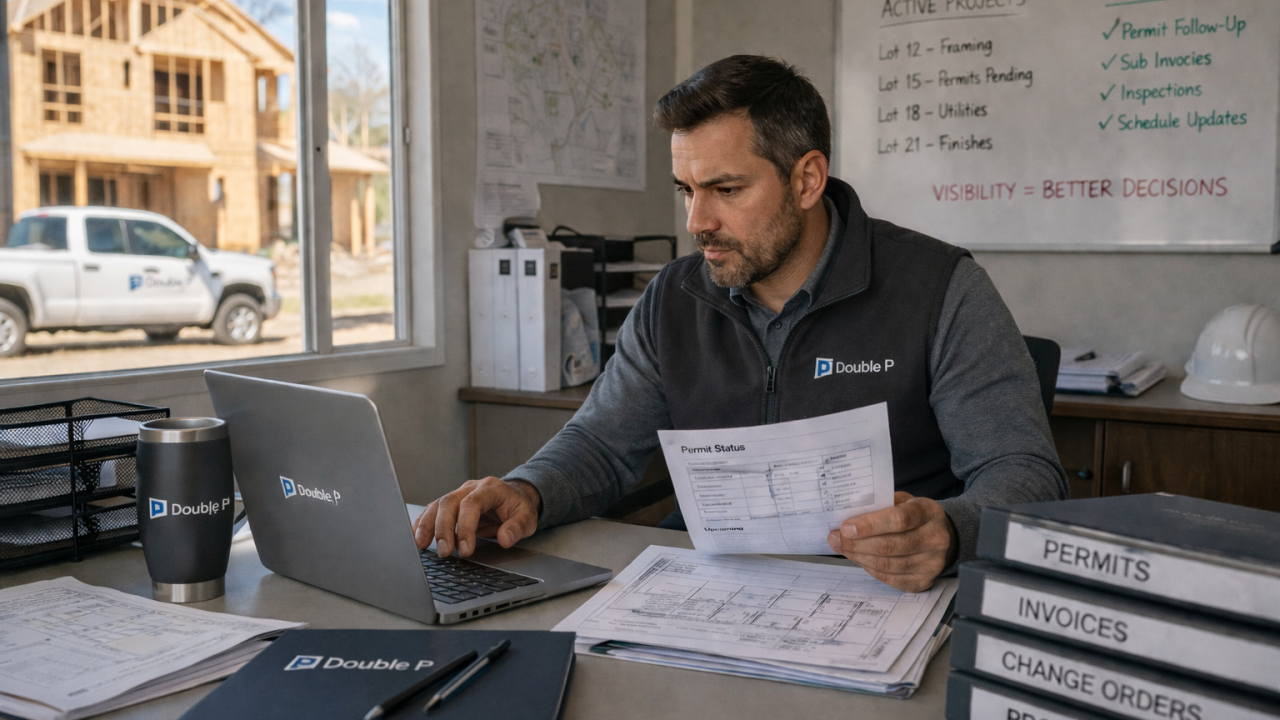

Most residential builders don’t struggle because they lack skill. They struggle because the business around the skill hasn’t kept up. […]
Most residential builders don’t struggle because they lack skill. They struggle because the business around the skill hasn’t kept up.
At two or three projects, a sharp builder can hold everything in his head — who’s waiting on what, which permit is delayed, which sub needs to be paid this week. It works because the volume is manageable. The system is the builder.
Then the business grows. A fourth project gets added. A fifth. And the same approach that worked at three projects starts to break down. Not dramatically — not all at once — but in small, compounding ways. A document doesn’t get filed. A follow-up call doesn’t happen. An invoice sits in the wrong place for two weeks. Each one is a minor issue. Together, they become the reason growth feels harder than it should.
This is the point where many builders start looking for operational support. And this is also the point where most of them look for the wrong thing.
The Task-Offloading Trap
The first instinct when things feel overwhelming is to find someone to take tasks off your plate. Handle the paperwork. Follow up on the permits. Organize the invoices.
This is not wrong. But it is incomplete.
Task offloading gives you relief. It does not give you control. And for a growing construction business, relief without control just means you’re slightly less overwhelmed while the underlying gaps keep producing the same problems.
A builder who offloads permit follow-up to someone who doesn’t have a clear system for tracking submissions, status, and deadlines hasn’t solved the permit problem. He’s moved it one step away from himself. When the delay hits — and it will — he still doesn’t know about it until it’s already affecting the schedule.
The question isn’t “who can handle this for me.” The question is “what does my operation need to function without me holding it together personally.”
What Operational Support Actually Needs to Deliver
For a residential builder managing multiple active projects, strong operational support should solve for four things specifically.
Permit visibility without follow-up. Every active permit should have a known status at any point in time. Not because you called to ask, but because there is a system tracking submissions, agency responses, outstanding items, and next steps. When a permit is delayed, you find out the same day — not two weeks later when a sub shows up to a job that can’t start.
Invoice and payment clarity. Money moving in and out of a construction business is rarely simple. Multiple subs, multiple projects, retainage, change orders, lien waivers — the paper trail gets complicated fast. The job of operational support is to make sure every invoice is logged, tracked, and visible. Not buried in an inbox. Not waiting on someone to remember. When you want to know where your cash is, the answer should take thirty seconds.
Document control that doesn’t depend on one person. Contracts, scopes, change orders, inspection reports, photos — every project generates a volume of documentation that directly affects your legal and financial standing. A builder who keeps these in his email, on his phone, or in a folder nobody else can access is one bad week away from a real problem. Strong support means every document is organized, stored, and accessible — and the system holds even when a team member changes.
Project coordination that keeps subs and vendors moving. Most delays don’t start at the permit office or on the job site. They start when a sub doesn’t get a confirmed schedule, when a material delivery window isn’t followed up on, or when a change order doesn’t get communicated to the right people in time. Operational support should be actively closing those loops — not waiting for the builder to notice they haven’t been closed.
The Visibility Standard
There is a simple way to evaluate whether your operational support is actually working: can you, at any given moment, describe the status of every active project without opening your phone or calling anyone?
Most builders cannot. That is not a failure of effort. It is a failure of structure. And it is the problem that operational support should be designed to fix.
When the structure is right, a builder’s job changes. Instead of managing the chaos of information — chasing statuses, tracking down documents, following up on things that should already be handled — he makes decisions. He talks to clients from a position of clarity. He evaluates new opportunities without wondering if his current operation can handle them.
This is not about hiring more people. It is about building the right support layer around the work that is already happening.
What Changes When the Support is Right
The immediate change is that the builder stops being the bottleneck in his own business. Permits get tracked. Invoices get processed. Subs get the information they need. Documents are where they’re supposed to be.
But the longer-term change is more significant. A builder with operational clarity can make better decisions about growth. He knows what his capacity actually looks like, not just what he hopes it looks like. He can take on a new project without worrying that the one currently in progress is going to fall through the cracks. He can have a direct conversation with a client about timeline or cost because the information supporting that conversation is accurate and accessible.
That is what operational support is supposed to deliver. Not just less stress — a more capable business.
Conclusion
There is no shortage of builders who are skilled enough to build more. What holds most of them back is not talent and not opportunity. It is the back office. The systems that should be keeping the business running quietly in the background are instead creating constant friction — permits that nobody’s tracking, invoices that aren’t visible, projects that depend entirely on the builder’s own memory to stay on schedule.
Strong operational support does not solve this by adding bodies. It solves it by building the structure that the business has outgrown needing — but never got.
If you’re at the point where your current operation can’t quite keep up with the work you’re doing, that gap is worth examining before it gets wider. A free 30-minute conversation is a reasonable place to start: calendly.com/ppineda-doublepdevelopment/30min
Streamline your permitting process now.
Our expert team handles every submission, follow-up, and compliance hurdle so you can focus on building.